Cooling systems
The control of the environmental conditions for educational facilities directly impacts the performance of the students and staff that occupy the space. One of the elements which control environmental conditions is the cooling (air conditioning) system selected. There are five categories of cooling systems with several variations within each. This section will highlight these five categories looking at appropriate climate zones to use, cost effectiveness, benefits, and operation and maintenance.
The five categories cooling to be described are:
a. Natural
b. Evaporative
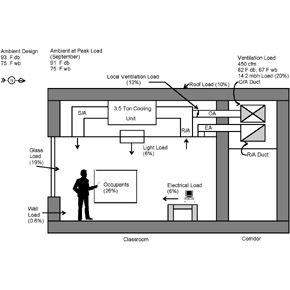
c. Direct expansion
d. Chilled Water Plant
e. Geo-Exchange

|
  |
|
Natural Cooling – a. Cross ventilation/cooling – This method
depends on the movement of air through the space to equalize the
pressure. Wind which blows against a wall or barrier is deflected
around and above the barrier creating a higher pressure on the
windward side of the building. b. Stack ventilation/cooling
– This method depend on the difference in air densities to provide
air movement in the teaching space. Two vents are needed for this
method to work.
Evaporative cooling -- is an alternative to air-conditioning with low energy costs because no compressor is needed, only a fan and a pump. This method is good for educational areas with high outside air ventilation requirements. Evaporative cooling can be either direct or indirect. Direct cooling involves the water being exposed to an air stream.
Direct Expansion, or "DX" -- cooling uses the vapor compression refrigeration cycle in which a fluid called a refrigerant moves heat from one part of the cycle to another. I
Chilled-water system -- the entire system lives in a mechanical room or behind the building. It cools water to between 40 and 45 F (4.4 and 7.2 C). This chilled water is then piped throughout the building and connected to air handlers as needed.
The earth around an educational facility can serve as a heat and
cooling source when energy unit cost is high and climbing. These
system are known by many names include geothermal, earth-coupled,
ground-coupled, close-loop and water-coupled. They all use a fluid
transported by a hydronic system through a Ground Source Heat
Pump (GSHP) to either remove heat from the ground to the air in
a space when heat is needed or to transfer the heat from a space
to the ground when cooling is required using a refrigeration cycle.
|