|
Windows
Windows are still the least insulating part of the thermal envelope
with a heat loss coefficient, a U-value, that is typically 4-10
times higher than that of other thermal envelope elements. At
one time this lead to the use of very small window areas at the
expense of the daylight level, but concurrently with development
of improved insulating glazing, the size of typical window areas
has again increased.
In the pdf-file the present state of windows is reviewed with
emphasis on energy conditions and the report is divided in the
following chapters: "Sealed units" (low-emissivity cooatings,
gas fillings, edge fillings), "Frame constructions", "U-value/g-value",
"An overview of existing soliutions" and finally "Research and
development" (superinsulating glazing and improved frame constructions
and g-value). Special products like solar protection glazing and
security glazing are not described.
|
  |
|
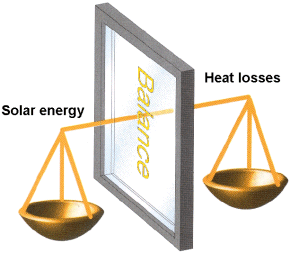
Windows are built up of a number of components (glass type, gas
filling, spacer, frame) that can be combined so that in each case
the window meets the requirements made to insulating properties,
daylight conditions, solar shading, noise reduction etc. It is
not always clear how the U- and g-values should be weighted in
relation to each other, as other conditions may be determining
for the actual case such as the orientation of the window, shadow
conditions, the thermal mass of the building, internal heat load
etc. In each renovation case an assessment/calculation should
be made to find the optimum choice of window in terms of energy.
Well-insulated pane types, i.e. panes with a centre U-value of less than approx. 1 W/(m2 K)), sometimes present an aesthetic problem of condensation on the exterior of the pane. Condensation is primarily present on clear, silent nights but will first disappear late in the morning or towards noon. Time will show how much this will influence the user's opinion of well-insulated windows.
Today most window glazing manufacturers use 0.4 mm galvanised steel for spacers but in a few cases insu-lating spacers are used, primarily to avoid condensation on the interior of the pane, while the energy aspect rarely leads to the use of improved spacers.
In the field of frames practically no development has occurred
toward improved insulating constructions as the main efforts of
manufacturers focus on reduction of maintenance costs. Narrow
frame constructions are marketed with a frame height of approximately
half of what is found in traditional windows. In contrast the
U-value is a great deal higher, but this is partly compensated
for by a smaller frame area.
|