|
Control systems
A large variety of glazing or selective coatings is proposed by
the manufacturers, some of them devoted to protect internal spaces
from excessive light, reducing the brightness glare of the glazing
and heat with respect of luminous performance.
Three innovative trends are particularly attractive :
an active control of transmittance, an angular selective coating,
obtained thanks to anisotropic coatings, a light scattering or
deviation surface e.g. prismatic surfaces which displace the incident
light sideways, arrays of microlens which act as controlled diffusers,
etc.
An important advantage of fixed shading devices is that they are
passive or self operating. However they have an impact on the
aesthetic of the facades and must be robust enough to resist snow
loading.
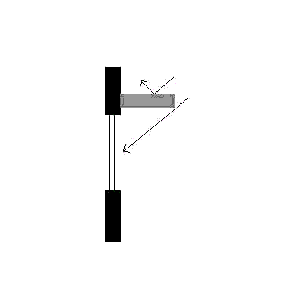
Orientation, inclination and geometry of fixed overhangs and fins
must be carefully analysed .
|
  |
|
Movable shading control systems are more responsive than the fixed
shading devices, but their movement mechanisms can present installation
and maintenance problems.
For external ones, weather implies some robustness constraints and sometimes some control implications.
Combination of a movable outdoor shading device and an indoor
light blind offers best opportunities to control solar gains all
year long.
|